
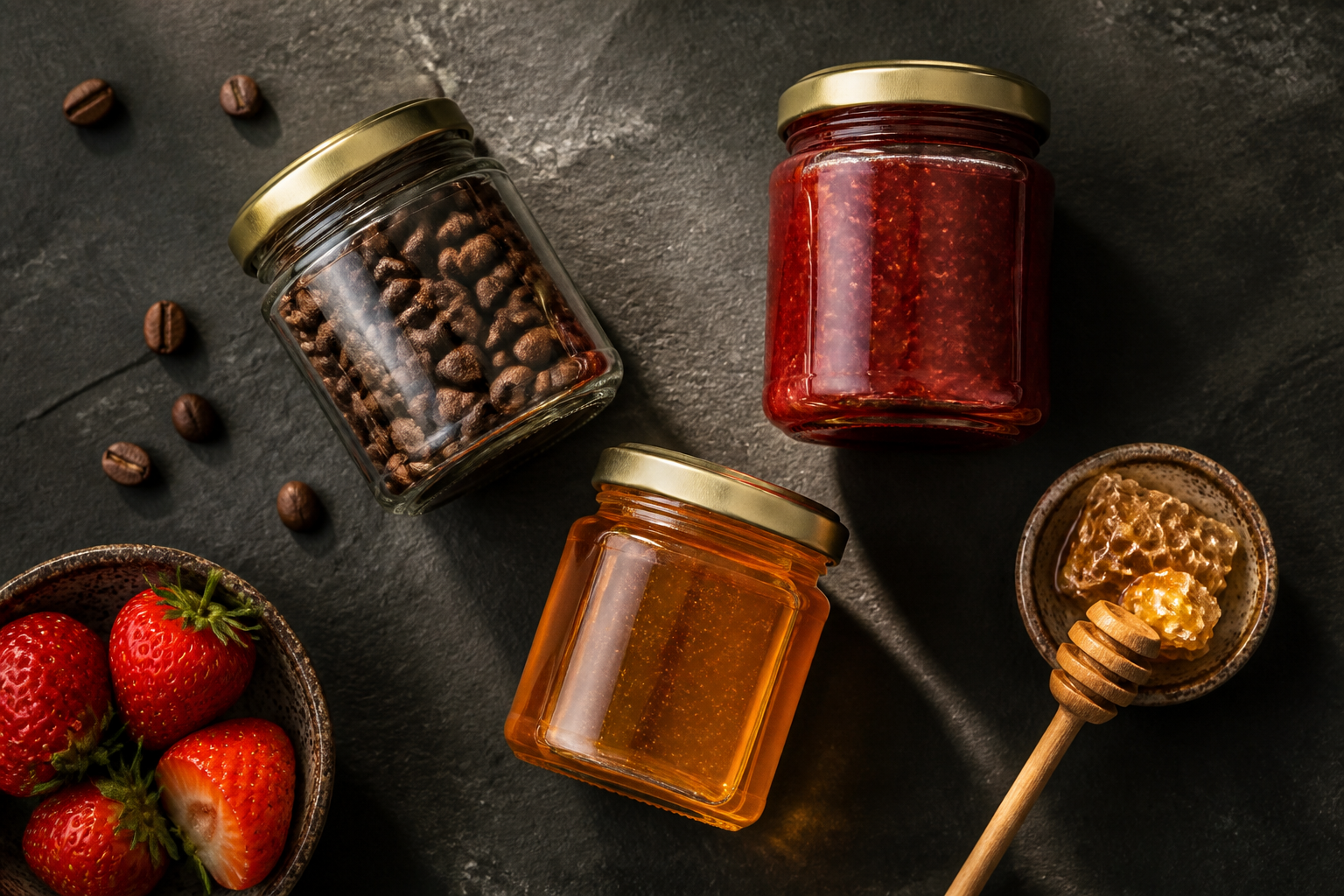

Choosing the Right Glass Jar for Coffee, Preserves & Specialty Foods
Selecting the right glass jar involves more than aesthetics. This guide covers the critical decisions brand owners must make regarding shape, volume, closure type, and supplier credentials to ensure product integrity and shelf appeal for coffee, preserves, and specialty foods.
The best glass jar for specialty foods like coffee and preserves depends on the product's preservation needs and brand positioning. For hygroscopic products like instant coffee, a wide-mouth jar with an airtight seal is crucial to prevent moisture ingress and preserve aroma. For preserves, a vacuum-sealable lug or twist-off cap is standard for safety and extended shelf life. Beyond the shape, brand owners must consider the glass type (e.g., clear flint vs. UV-protective amber), closure system, and the supplier's quality certifications, such as FSSC 22000, to ensure food safety and product integrity.
Choosing a glass jar requires balancing three factors: product protection, brand experience, and operational reliability. The jar and its closure must protect against primary spoilage risks like oxygen, moisture, and light. Aesthetically, the jar's shape, weight, and clarity communicate brand value. Operationally, you need a supplier who can meet your volume needs, comply with food safety standards, and provide consistent quality.
- What is your product's primary spoilage risk (e.g., oxidation, moisture, microbial growth)?
- What filling process will you use (hot-fill, cold-fill, aseptic)?
- Does your brand perception call for a premium, heavy-base feel or a lighter, eco-conscious profile?
- What are your volume requirements, and can your supplier offer flexibility for initial or short runs?
- Does the supplier hold relevant food safety certifications like FSSC 22000?
- Have you qualified both the jar and the closure system for compatibility and performance?
Key Jar Characteristics by Product Category
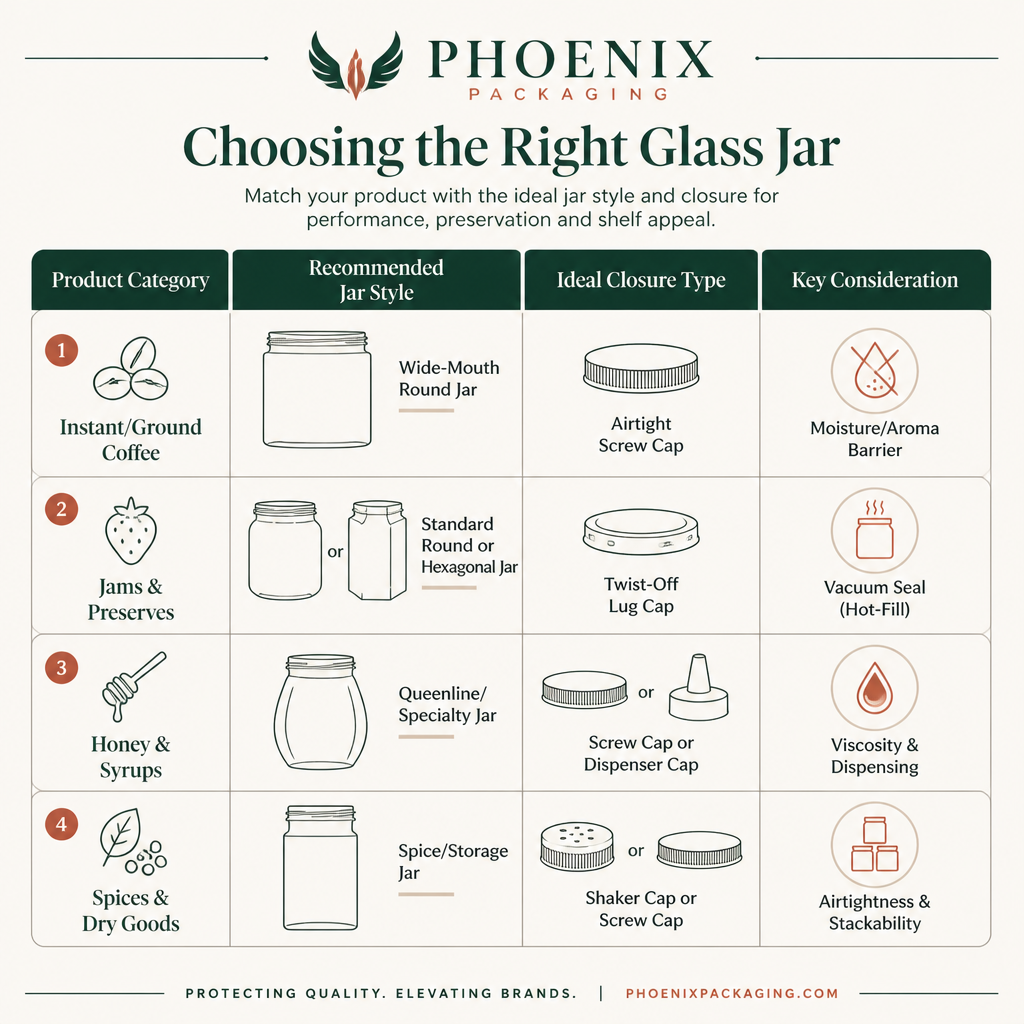
The optimal jar specification is dictated by the contents. A jar designed for the acidic, hot-filled environment of a chutney is fundamentally different from one intended for freeze-dried coffee granules. The primary considerations are barrier properties (protecting the product from the environment) and interaction (ensuring the packaging does not alter the product).
As the European Container Glass Federation (FEVE) notes, glass is valued for being chemically inert, meaning it doesn't interact with its contents. This quality ensures that the original taste and aroma of your product are perfectly preserved, free from any packaging-derived taint. This makes it a superior choice for premium food products where flavour integrity is paramount.
| Product Category | Common Jar Styles | Recommended Closure | Typical Filling Process | Key Considerations |
|---|---|---|---|---|
| Instant/Ground Coffee | Wide-mouth Round, Squat | Screw Cap with Induction Seal or Gasket | Cold-fill (ambient) | Airtight seal is critical to prevent moisture clumps and aroma loss. Consider amber glass for UV protection of sensitive grounds. |
| Jams & Preserves | Orcio, Hexagonal, Round | Twist-off / Lug Cap | Hot-fill | Must achieve a vacuum seal post-filling (indicated by a tamper-evident button 'pop'). Glass must withstand thermal shock. |
| Chutneys & Pickles | Round, Square, Mason | Twist-off / Lug Cap with acid-resistant liner | Hot-fill or Cold-fill | Liner material must be resistant to acidic ingredients (vinegar). A good vacuum seal prevents spoilage. |
| Honey & Syrups | Queenline, Square, Specialty Shapes | Screw Cap, Dispenser Cap | Warm-fill or Cold-fill | Clarity of flint glass showcases product colour and purity. Closure choice impacts user experience (e.g., non-drip). |
Closures: The Critical Seal
The closure is as important as the jar itself. A mismatched closure can compromise food safety, shorten shelf life, and damage brand reputation. The choice depends entirely on the product and filling process.
Supplier Quality and Food Safety
When sourcing jars, especially from suppliers in Malaysia or across Southeast Asia for export, verifying their quality management and food safety credentials is vital. Your packaging partner is an extension of your brand's quality promise.
Look for suppliers whose manufacturing partners are certified against internationally recognised standards. The FSSC 22000 standard for packaging manufacturing provides a framework for managing food safety responsibilities. It demonstrates a robust system for producing safe, legal, and authentic packaging materials. Similarly, certifications like ISO 9001:2015 show a commitment to consistent quality management.
Plan Your Next Specialty Food Launch
Our team can help you navigate the technical requirements of glass jar and closure selection to match your product and brand goals, whether you need a standard shape or a fully custom solution.
Sources used in this article
- 1
- 2
- 3ISO 9001:2015 Quality Management SystemsInternational Organization for Standardization
Frequently asked questions
What is the typical minimum order quantity (MOQ) for custom glass jars?

MOQ for fully custom jar designs typically starts from a full furnace run, which can be substantial. However, for modifications to existing shapes or for certain standard items, Phoenix Packaging can often provide short-run flexibility, with volumes around 5,000 to 10,000 units being a feasible starting point for discussion.
Can glass jars be used for both hot-fill and cold-fill products?
Yes, glass is suitable for both. However, jars intended for hot-filling must be designed and tested to withstand thermal shock—the stress induced by rapid temperature change. It's crucial to confirm with your supplier that the specific jar has passed thermal shock testing appropriate for your filling process.
How do I ensure my coffee jar is truly airtight?
An airtight seal for a coffee jar is achieved through the closure system. The most effective solution is typically a screw cap combined with a multi-layered liner that is heat-sealed to the jar's rim after filling (an induction seal). This creates a hermetic, tamper-evident barrier that protects against moisture and oxygen.
What does FSSC 22000 certification mean for a glass jar supplier?
FSSC 22000 is a globally recognised food safety certification specifically for the manufacturing of materials, including food packaging. When a supplier's partner plant is FSSC 22000 certified, it demonstrates that a rigorous food safety management system is in place, covering hygiene, hazard control, and traceability, which is crucial for brand owners.
Have a packaging brief?
Tell us your product, target volume and launch market — we'll come back with a route that fits.