

Glass Jar Supplier Malaysia: What Food Brands Should Check Before Ordering
When sourcing glass jars in Malaysia, food brands must look beyond price. This guide covers the critical checks for food safety certification, quality assurance, technical compatibility, and supply chain reliability.
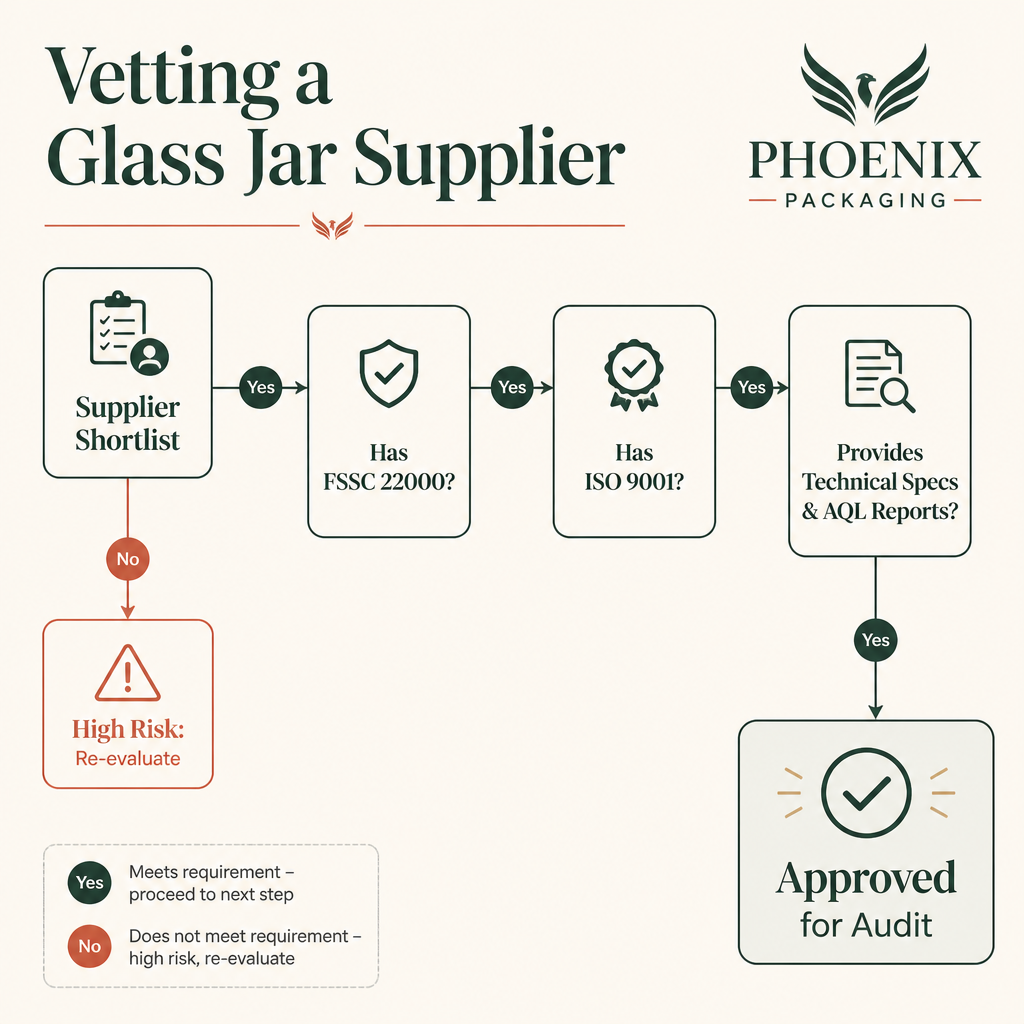
When selecting a glass jar supplier in Malaysia, food brands must prioritise food safety certification, quality assurance, and logistical reliability. Focus on partners who can provide evidence of FSSC 22000 certification, demonstrating commitment to food safety. You should also verify their quality management systems, such as ISO 9001, and their capabilities for technical support, including closure compatibility and consistent quality checks. A reliable partner manages the entire supply chain, ensuring your packaging aligns with production and brand standards.
Choosing the right supplier for food-grade glass jars in Malaysia is a critical decision that impacts product safety, brand reputation, and operational efficiency. The evaluation process should extend beyond a simple price comparison to a thorough assessment of the supplier’s quality systems, technical expertise, and logistical infrastructure. Prioritising suppliers with internationally recognised certifications ensures a baseline of quality and safety, mitigating risks associated with food contact packaging.
- Does the supplier hold FSSC 22000 certification for packaging manufacturing?
- Can they provide evidence of a robust Quality Management System, like ISO 9001?
- Do they offer comprehensive technical support for jar and closure compatibility?
- Are their Minimum Order Quantities (MOQs) aligned with your production forecasts?
- Can they guarantee supply chain reliability and provide clear logistical coordination?
- Do they offer an end-to-end service, from sourcing to final delivery?
Food Safety and Quality Management Systems
For food packaging, nothing is more important than safety. The inert nature of glass makes it an ideal material for preserving food, as it prevents interaction between the packaging and the product. However, the manufacturing process itself must be managed under strict controls to prevent contamination. This is where certifications become non-negotiable.
The most important standard to look for is FSSC 22000. This scheme, recognised by the Global Food Safety Initiative (GFSI), provides a framework for managing an organisation's food safety responsibilities. It ensures the manufacturer of your glass jars operates with processes designed to produce safe products. Paired with ISO 9001:2015 for quality management systems, it signals a supplier's commitment to repeatable, high-quality outcomes and continuous improvement.
At Phoenix, we partner exclusively with plants that are certified to these rigorous international standards, ensuring every jar we supply meets the necessary safety and quality benchmarks for our food and beverage clients.
Technical Capabilities and Product Fit
A supplier should be more than just a source of jars; they should be a technical partner. This starts with ensuring the jar itself is fit for purpose. Will your product be hot-filled, pasteurised, or retorted? The glass must be able to withstand the thermal shock. Does your product require UV protection? An amber or coloured glass might be necessary.
Equally critical is the closure. The jar's neck finish must be perfectly compatible with the lid to ensure a hermetic seal, protecting your product from spoilage and maintaining freshness. A knowledgeable supplier can guide you through the options, from standard twist-off caps to more specialised closures. You can explore this topic further in our guide to food packaging closures.
Phoenix Packaging provides this technical oversight as a core part of our service, managing everything from custom design specifications to final quality checks.
| Closure Type | Sealing Mechanism | Common Applications | Considerations |
|---|---|---|---|
| Twist-Off (Lug Cap) | Plastisol-lined lugs grip jar threads. Creates vacuum seal. | Jams, preserves, pickles, sauces, passata. | Excellent for hot-fill and pasteurisation. Tamper-evident button is standard. |
| Continuous Thread (CT) | Screw-on cap with continuous thread. | Dry goods (spices, herbs), honey, some sauces. | Not typically suitable for high-vacuum processes. Sealing liner is critical. |
| Press-Twist (PT) | Hybrid of press-on and twist-off. | Baby food, premium cooking sauces. | Requires precise application torque. Offers high security and premium feel. |
| Pry-Off | Requires a tool to open. Creates a very strong seal. | Classic condiment jars, pâté. | Less convenient for consumers but offers maximum seal integrity. |
Volume, Logistics, and Supply Chain
Understanding a supplier's production and logistical capabilities is essential for maintaining your own production schedule. Minimum Order Quantities (MOQs) are a primary consideration. A typical full production run at a glass plant can be very large, which may not suit brands launching new products or requiring smaller batches. It's crucial to have a clear conversation about volume requirements and flexibility. For more detail, see our exploration of what drives glass MOQ.
Phoenix often helps bridge this gap. We offer flexibility for certain projects, with short-run capabilities sometimes available for orders between 5,000 and 10,000 units by leveraging our unique relationships with partner plants.
Beyond MOQs, assess the supplier’s entire supply chain. Enquire about lead times from order placement to delivery, warehousing options in Malaysia, and their process for managing freight and customs clearance. A strong partner will provide visibility and proactive communication throughout the process, backed by robust quality assurance protocols like AQL inspections before shipment.
Build a reliable glass jar supply chain in Malaysia.
Our team can help you navigate the complexities of sourcing, quality assurance, and logistics for food-grade glass packaging.
Sources used in this article
- 1
- 2ISO 9001:2015 Quality Management SystemsInternational Organization for Standardization
- 3
Frequently asked questions
What is the most important certification for a food glass jar supplier?

FSSC 22000 is critical. It's a globally recognised standard for food safety management systems, specifically covering packaging manufacturing. It ensures the supplier has robust processes in place to prevent contamination and deliver safe, food-grade jars.
Can I get custom-designed glass jars in Malaysia?
Yes. While it often requires higher initial investment for mould development and larger volume commitments than stock jars, custom design is possible. A packaging partner like Phoenix can manage the entire process, from technical drawings and mould development to production and quality control with our network of certified plants.
What is a typical Minimum Order Quantity (MOQ) for glass jars?
MOQs vary significantly depending on the jar, manufacturing plant, and whether it's a stock or custom item. A standard production run for a furnace is often in the hundreds of thousands of units. However, partners like Phoenix can sometimes offer solutions for smaller volumes, with short-run flexibility discussed for orders around 5,000 to 10,000 units by utilising partner plant stock or shared production allocations.
How do I ensure the closures will work with my jars?
This is a critical technical check. Your supplier must provide detailed technical specifications for both the jar neck finish and the recommended closure. They must confirm compatibility, especially for processes like hot-filling or pasteurisation that require a hermetic seal. Phoenix provides this technical validation service as part of our end-to-end solution.
Have a packaging brief?
Tell us your product, target volume and launch market — we'll come back with a route that fits.